Documented artwork / ecological field experiment and site-specific artwork
Revival Field
Credit as documented: Mel Chin in collaboration with Dr. Rufus Chaney (USDA research agronomist)
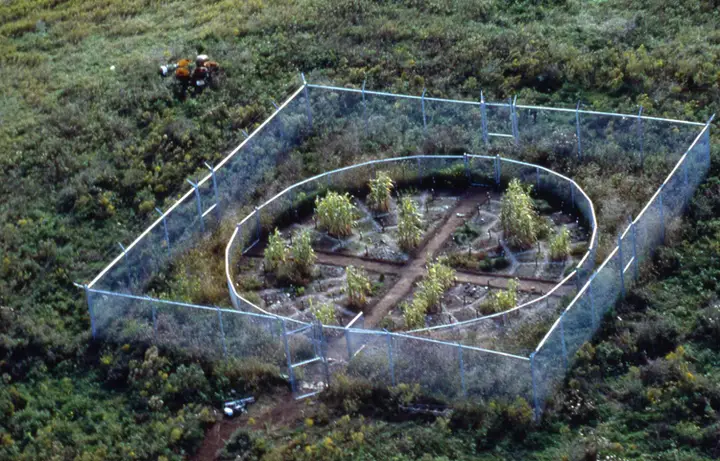
Revival Field approaches an altered landscape as both an artwork and an experiment. Mel Chin worked with USDA agronomist Dr. Rufus Chaney on an initial field trial at Pig's Eye Landfill in St. Paul, Minnesota. The artist dates the project from 1991 and identifies 1993 as the end of its first phase. Plants capable of concentrating metals were arranged within industrial fencing on the contaminated site, linking the composition's circular planting scheme with the prospect of changing the soil itself.
Already working on a project?
Adds directly to your existing saved project and keeps its brief intact.Documented work. Current availability, ownership and installation requirements must be confirmed with the artist.
At a glance
- Year / version
- 1991 onward; initial field phase concluded 1993 (artist)
- Materials
- plants, industrial fencing
- Documented setting
- outdoor
- Dimensions
- Not documented
- Dimensions apply to
- Not documented
- Availability
- Unconfirmed
Places & versions
Installation history
Historical presentations. A past installation does not establish the current location or suitability for a new site.
1991–1993 initial phase
Pig's Eye Landfill, St. Paul, Minnesota
- Site
- Pig's Eye Landfill
- City
- St. Paul
- State / region
- MN
- Country
- United States (inferred; not independently confirmed)
Installation details checked 2026-10-17.
Materials and construction
Chin reports that biomass analysis found cadmium accumulation in a tested Thlaspi variety despite difficult soil conditions. This is a documented experimental result, not a claim that the entire landfill was cleaned or made safe. The page's small-scale measurements belong to a separate maquette.
From a reference to your project
Keep the idea.
Shape the brief.
Save this reference to your shortlist while you explore. Review your selection, then carry the references you choose into a commissioning brief for your site, audience, timing and open questions.
Your shortlist is saved on this device. Saving a reference does not contact the artist or reserve a work. Participation, availability, price and site suitability need confirmation.
Plan the next step
Sources
- melchin.org ↗ · Checked 2026-10-16
- melchin.org ↗ · Checked 2026-10-17