Research notes for project planning
What the project record tells us
Documented VTA station work; installation year not established.
Everyday objects form a transit landmark
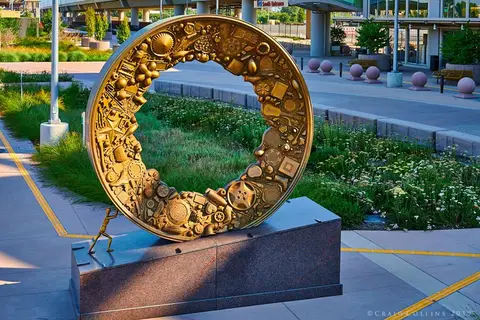
LIFE! at the Berryessa/North San José station builds a large bronze wheel from the shapes of ordinary objects, paired with a figure pushing it on a granite support. Kirkland’s account identifies Walla Walla Foundry’s role in molding and casting the collected forms. For a transit buyer, this is a useful production precedent: recognizable detail and large-scale composition require different reviews. A new brief should connect approval of the object vocabulary with review of the full assembly, structural support and how commuters encounter it.
Larry Kirkland — LIFE! ↗ · Reviewed 2026-10-10
For your project briefHow will detailed objects and the overall assembly be reviewed together?
Big Art Partners planning prompt 1988 installation; MOA assistance does not imply museum ownership.
Suspension changes the room rather than its floor
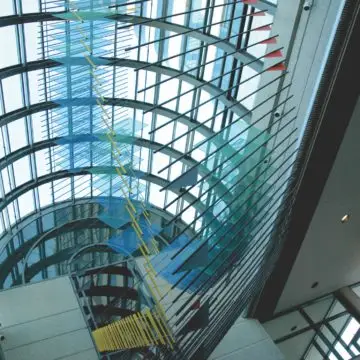
Flywheel is documented by the Museum of Outdoor Arts as a 1988 installation at Plaza Tower One in Greenwood Village. Its suspended metal, wood and screen assembly is described through changing viewpoints and light. The museum also clarifies that it assisted acquisition and installation without owning the work. For an atrium buyer, both facts matter: ceiling attachment and servicing need planning, and ownership should be explicit. A comparable project should assign inspection, access equipment and long-term care to the responsible building or collection owner.
Museum of Outdoor Arts — Flywheel ↗ · Reviewed 2026-10-10
For your project briefWho owns and maintains the suspended artwork and its supports?
Big Art Partners planning prompt Practice context for documented transit sculpture; planning advice is editorial.
Research should have a defined place in the scope
Kirkland’s process account describes learning from local people, historical material and everyday work before developing the forms of an artwork. It also identifies fabrication as a collective effort involving specialist trades. Read alongside LIFE!, this provides a useful commissioning framework for art that draws on community experience. A buyer should define the research access it can provide and agree on the point at which concepts become drawings and models, while leaving room for the artist’s interpretation to develop through those conversations.
Larry Kirkland — Process ↗ · Reviewed 2026-10-10
For your project briefWhat community access and concept-review milestones will the buyer provide?
Big Art Partners planning prompt