Research notes for project planning
What the project record tells us
Seattle Center installation; collaborators retained; award date not treated as completion date.
A threshold can be made from repeated forms
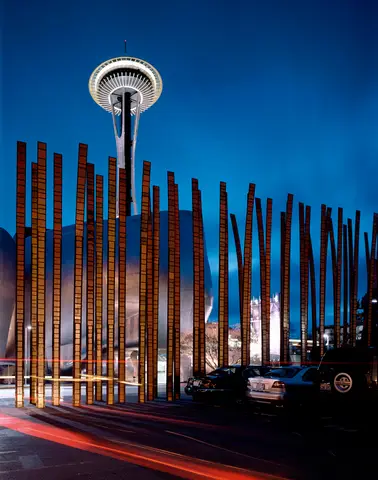
Grass Blades at Seattle Center uses a field of painted steel elements to guide entry and screen a parking area. Fleming’s project account identifies 110 blades and credits Rohleder Borges Fleming Architecture and Susan Zoccola as collaborators. For a campus or cultural-site buyer, this offers a precedent for art that helps define an edge. The commissioning brief should examine movement through the threshold, views across it and the maintenance space between repeated elements, with responsibilities coordinated across the artistic and architectural design team.
John Fleming — Grass Blades ↗ · Reviewed 2026-10-10
For your project briefHow will the repeated forms shape access, views and maintenance?
Big Art Partners planning prompt Seattle market installation; source records 200 workshop participants.
Workshop contributions can become a building-scale surface
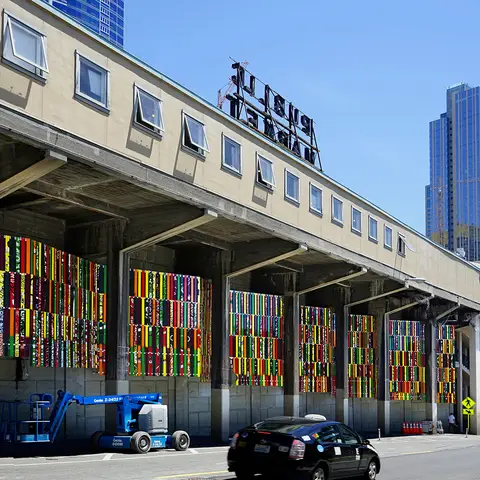
Western Tapestry at Pike Place Market combines approximately 1,700 aluminum strips, with workshop participants contributing to their decoration. Fleming’s account connects the colors to the market and describes changing LED illumination at night. For a market or community-space buyer, the precedent links participation directly to a permanent architectural installation. A comparable project should define how individual contributions are documented, assembled and approved, and how future replacement pieces can respect that shared authorship while keeping the larger surface visually coherent.
John Fleming — Western Tapestry ↗ · Reviewed 2026-10-10
For your project briefHow will repairs preserve the participants’ contributions?
Big Art Partners planning prompt Documented LSU project; no unsupported material, dimensions or date added.
A familiar tree becomes a reflective encounter
Reflectivity at Louisiana State University takes a campus live oak as its reference and uses a mirrored canopy to reflect the people around it. Fleming’s description is brief, but it establishes a specific relationship between a familiar local form and the visitor’s own movement. For a university buyer, this is a useful prompt for site selection: evaluate the surrounding trees, buildings and pedestrian routes that a reflective surface will draw into the work. Surface care and accessible viewing positions belong in that discussion.
John Fleming — Reflectivity ↗ · Reviewed 2026-10-10
For your project briefWhat surrounding views will the reflective canopy bring into the work?
Big Art Partners planning prompt