Research notes for project planning
What the project record tells us
Artists’ retrospective account of the 2017 Chengdu installation.
Local fabrication followed the artists’ plans
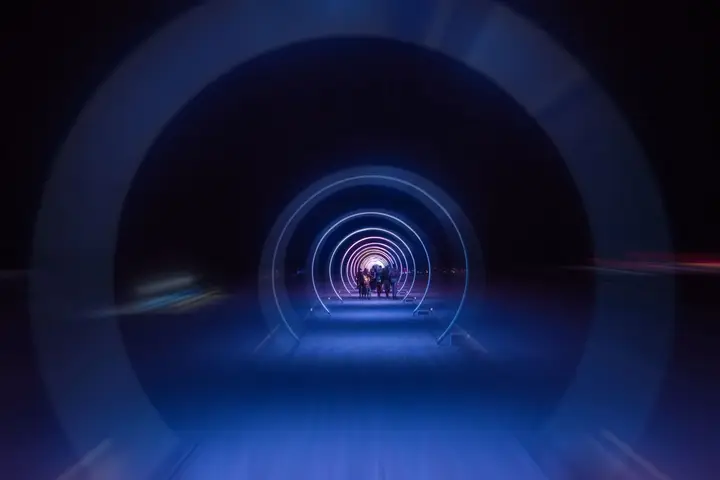
In their joint account of Sonic Runway’s first international installation, Warren Trezevant and Rob Jensen describe a new version fabricated in Chengdu from their construction drawings and parts list. Thomas Thompson of Manifestory China assembled the local technical team; the artists rebuilt control software and developed new light patterns before arriving to commission the system. The installation then supported live performances and public strolling. A buyer considering local fabrication should ask how design documentation, fabrication review and on-site software testing will be divided between the artists and local team.
Rob Jensen and Warren Trezevant — Burning Man Journal ↗ · Reviewed 2026-10-10
For your project briefHow will documentation, fabrication review and on-site commissioning be shared with a local team?
Big Art Partners planning prompt Retrospective credits for animation and breathing-motion design on other artists’ sculptures.
Animation is a distinct contribution to sculpture
Trezevant’s biography on the Ripple project site identifies his animation work for Peter Hudson’s Charon and Eternal Return, along with his design of the breathing motion for Marco Cochrane’s R_Evolution. These credits locate his contribution within collaborative sculptures whose authorship remains with the named artists. For a buyer, they make movement design a useful scope to discuss explicitly: which poses, rhythms or breathing cycle carry the intended character, and how will that motion be reviewed with the sculpture’s artist and fabrication team before construction is complete?
Ripple — project team biography for Warren Trezevant ↗ · Reviewed 2026-10-10
For your project briefHow will the artist, motion designer and fabrication team review the intended movement before completion?
Big Art Partners planning prompt Museum account of Pixar’s Toy Story Zoetrope and Trezevant’s explanation of its animation sequence.
A sequence of poses becomes an exhibition lesson
In ACMI’s account of Pixar’s Toy Story Zoetrope, Warren Trezevant explains the value of seeing the sequence around the disc: visitors can inspect the poses preceding and following the one that appears to move. The museum also records that multiple versions traveled to museums and Disney parks. This makes the work a useful reference for an exhibit that reveals animation’s construction. A host should ask how visitors will encounter the stationary sequence and moving illusion, and how interpretation will explain the relationship between the two.
ACMI — zoetropes in pop culture ↗ · Reviewed 2026-10-10
For your project briefHow will visitors compare the visible pose sequence with the moving illusion?
Big Art Partners planning prompt