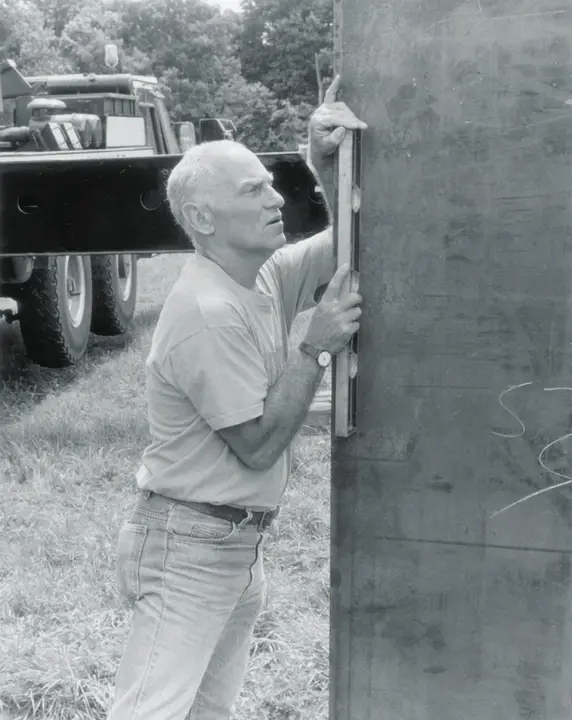
Richard Serra (1938–2024) made large-scale sculpture that organizes movement and the perception of space. Documented U.S. works include Schunnemunk Fork, Wake, and Joe. This record concerns his historical practice and existing works.
Saves on this device.Already working on a project?Adds directly to your existing saved project and keeps its brief intact.
Independent directory profile. Big Art Partners does not claim to represent this artist.
Not documented; confirm with the artist, studio or estate.
Research notes for project planning
What the project record tells us
Weathering-steel work distributed across sloping terrain
Site selection begins with the ground
Storm King describes Schunnemunk Fork as a 1990–91 work composed of steel plates placed in a rolling field. Serra used topographic maps, surveyors, and repeated walking to establish the relationship between the sculpture and its terrain. The resulting precedent is useful to BAP because the site was investigated as an active part of the work. A comparable planning discussion should examine grade, walking routes, and distant views before reducing a landscape commission to an object positioned on a site plan.
What site studies would reveal the experience of the work while walking through the landscape?
Big Art Partners planning prompt
Large curved-steel installation documented by Seattle Art Museum
Repeated modules and a changing bodily view
Seattle Art Museum’s catalog dates Wake to 2004 and describes five modules made from paired curved sections. Its account connects the fabrication to computer imaging and machinery associated with shipbuilding. The finished arrangement is understood through movement between and around the forms. For BAP, the historical example invites a discussion of how fabrication method, spacing, and public circulation jointly produce the experience. An impressive frontal image would provide only partial evidence for assessing a proposal that depends on people moving through it.
How would a review model demonstrate the views and clearances between repeated forms?
Big Art Partners planning prompt
Permanent courtyard sculpture at the Pulitzer Arts Foundation
A courtyard defined by a walkable spiral
The Pulitzer’s collection page identifies Joe as a 1999 torqued spiral and explains that Serra was invited to make a work for the museum’s opening. The sculpture establishes a route into and around a substantial steel form within the courtyard. This makes it a useful precedent for discussing the sequence between a building and an outdoor work. BAP should read it as a specific historical relationship between art and place, while asking how approach, enclosure, and return shape a visitor’s experience of comparable commissions.
Save this reference to your shortlist while you explore. Review your selection, then carry the references you choose into a commissioning brief for your site, audience, timing and open questions.
Your shortlist is saved on this device. Saving a reference does not contact the artist or reserve a work. Participation, availability, price and site suitability need confirmation.