Research notes for project planning
What the project record tells us
Madison Square Park interactive lighting
A participant becomes part of a lighting sequence
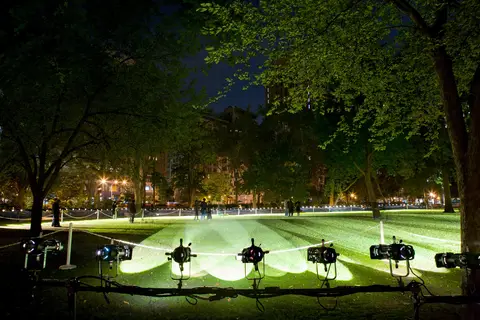
Pulse Park used heartbeat sensing to introduce participants’ rhythms into a field of 200 lights at Madison Square Park in 2008. The artist’s documentation identifies computer control and programming as part of the work, crediting Conroy Badger. This precedent makes the relationship between sensor, response and public scale especially clear. A commissioning brief should specify what a visitor does and what visible change follows before listing equipment. How will someone recognize their own contribution within the sequence produced by previous participants?
Rafael Lozano-Hemmer — Pulse Park ↗ · Reviewed 2026-10-10
For your project briefHow will a visitor recognize their contribution within the shared sequence?
Big Art Partners planning prompt Paired public interaction stations
Two sites must work as one encounter
Remote Pulse pairs stations so that a participant can feel another person’s heartbeat through vibration transmitted over the internet. First presented in connection with Border Tuner in 2019, the work makes a remote relationship tangible through a simple bodily action. Its documentation identifies different physical configurations and technical collaborators. A comparable brief should consider both endpoints as a shared experience, including how people discover the interaction. What happens for a participant when the other station is unoccupied or temporarily unable to connect?
Rafael Lozano-Hemmer — Remote Pulse ↗ · Reviewed 2026-10-10
For your project briefWhat happens when the other station is unoccupied or disconnected?
Big Art Partners planning prompt Binational light and conversation installation
Technology and public programming need coordination
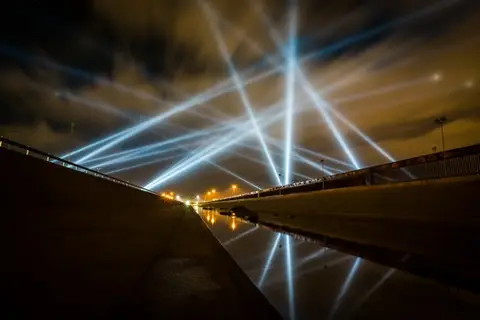
Border Tuner connected searchlight stations in El Paso and Ciudad Juárez in 2019, opening audio conversations when beams met. Its project documentation credits curators Kerry Doyle and León de la Rosa and identifies organized programming alongside public participation. The precedent shows that a communication system and the social conditions for using it are complementary parts of the work. A host should plan facilitation and community relationships with the technical installation. Who will help participants find the project and support the conversations it makes possible?
Border Tuner — project documentation ↗ · Reviewed 2026-10-10
For your project briefWho will support participants and the conversations the installation makes possible?
Big Art Partners planning prompt