Research notes for project planning
What the project record tells us
Museum-adjacent public park
A cloud as a park event
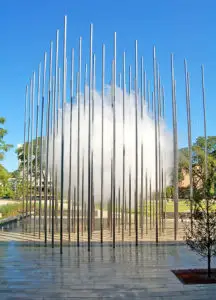
Cloud Arbor, completed in 2012 at Pittsburgh’s Buhl Community Park, releases fog inside a group of tall steel poles. Nozzles incorporated into the poles produce a cloud that forms and disperses repeatedly. Kahn credits collaboration with landscape architect Andrea Cochran and the Children’s Museum of Pittsburgh. The example makes water infrastructure part of a park’s changing experience. A comparable brief should establish who operates the fog system, what conditions interrupt operation and how visitors encounter the installation when the cloud is absent.
Ned Kahn — Cloud Arbor ↗ · Reviewed 2026-10-10
For your project briefWho operates the fog system, and what is the visitor experience when it is off?
Big Art Partners planning prompt Public rooftop park above a transit facility
Transit activity becomes a fountain score
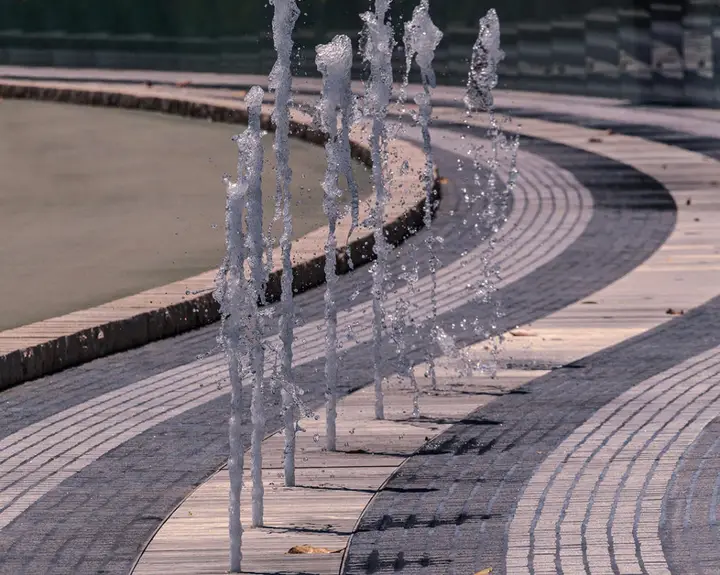
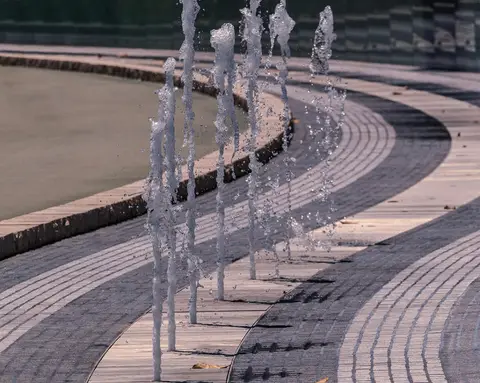
For Bus Fountain at San Francisco’s Salesforce Transit Center, Kahn connected a long rooftop fountain to bus movement below. Sensors above the bus route activate corresponding water jets, making transport activity legible through the park landscape. The artist dates the work to 2018 and names the architectural, landscape and fountain collaborators. This is a useful precedent for art tied to building operations. A commissioning team should define responsibility for sensor access, control-system changes and troubleshooting across the transit and landscape teams.
Ned Kahn — Bus Fountain ↗ · Reviewed 2026-10-10
For your project briefWho maintains the connection between transit sensors and fountain controls?
Big Art Partners planning prompt Early integration into civic design
Bring the artist into the design conversation
Kahn’s biography describes an environmental practice developed through collaboration with architects, engineers and landscape architects, including involvement early in project design. Cloud Arbor and Bus Fountain illustrate why that timing matters: their visible effects depend on systems and spatial arrangements beyond a freestanding object. For a new public setting, the initial brief should identify the natural or operational phenomenon the art will reveal. It should also establish which design disciplines can modify the site and who will own the resulting maintenance obligations.
Ned Kahn — Artist Biography ↗ · Reviewed 2026-10-10
For your project briefWhich project disciplines can still change the site to accommodate the intended phenomenon?
Big Art Partners planning prompt