Research notes for project planning
What the project record tells us
Kanazawa collection version, 2004
Two routes create the encounter
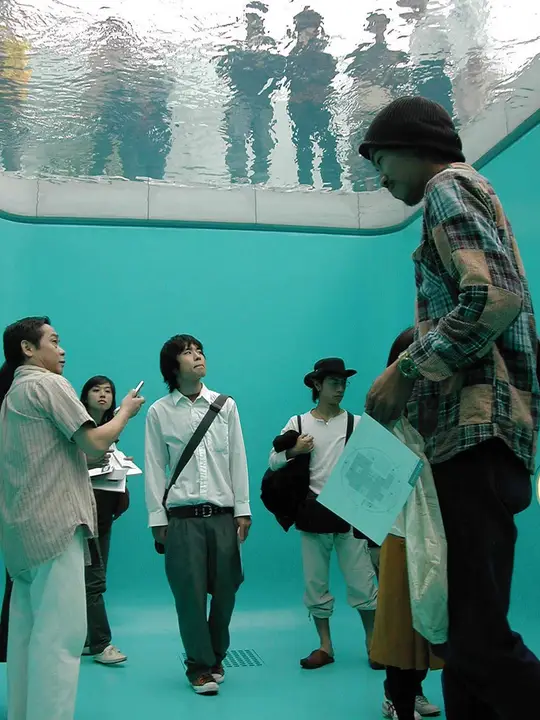
Kanazawa's collection record dates its Swimming Pool version to 2004 and identifies concrete, glass and water. Visitors above the work look through water supported by glass, while visitors below enter a dry chamber through the museum's underground route. The encounter depends on both perspectives being available, rather than on an image viewed from one position. For a comparable architectural illusion, an early site study should establish accessible routes between viewpoints and the operational responsibility for water, glazing and the visitor chamber.
21st Century Museum of Contemporary Art, Kanazawa — collection record ↗ · Reviewed 2026-10-10
For your project briefCan the site support accessible circulation between both viewpoints and maintain the glass-and-water system?
Big Art Partners planning prompt MoMA PS1 Duplex gallery presentation beginning in 2008
A gallery's section can shape an illusion
For Swimming Pool at MoMA PS1, Erlich used the Duplex gallery's two levels to separate the first sight of people apparently underwater from the later discovery of a dry space below. MoMA describes an acrylic surface supporting water above the chamber. This differs materially from Kanazawa's glass-based version, so neither account should become a universal specification. The useful planning precedent is the gallery section: entry order, vertical circulation and the reveal were part of how that particular installation worked.
MoMA — Swimming Pool exhibition archive ↗ · Reviewed 2026-10-10
For your project briefHow would entry order and vertical circulation preserve the intended reveal?
Big Art Partners planning prompt Buenos Aires Obelisk and MALBA intervention, 2015
A monument and a museum form one work
MALBA records La democracia del símbolo as a two-part intervention realized in Buenos Aires in 2015. The Obelisk appeared to lose its tip, while a corresponding structure at the museum let visitors enter what looked like the monument's upper section. The work connected a familiar civic landmark with a different, accessible viewing situation. For a comparable urban commission, the precedent makes coordination between sites central: permissions, public interpretation and the sequence of discovery would need to support one coherent experience.
MALBA — Liminal artist and project history ↗ · Reviewed 2026-10-10
For your project briefHow would the landmark and visitor site communicate as parts of one public experience?
Big Art Partners planning prompt