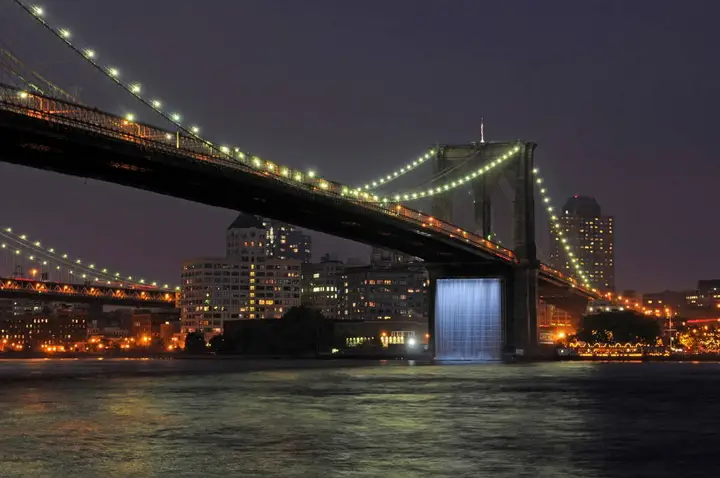
Olafur Eliasson creates installations involving perception, light, and environmental phenomena. Documented U.S. projects include The New York City Waterfalls, Seeing spheres in San Francisco, and One-way colour tunnel at SFMOMA.
Saves on this device.Already working on a project?Adds directly to your existing saved project and keeps its brief intact.
Independent directory profile. Big Art Partners does not claim to represent this artist.
Not documented; confirm with the artist, studio or estate.
Research notes for project planning
What the project record tells us
Temporary water installations at four waterfront sites
The mechanism remains part of the view
The studio’s account of The New York City Waterfalls describes four temporary waterfront installations in 2008, using pumps, hoses, and exposed scaffolding to produce falling water. The visible equipment connected the apparent natural phenomenon to its constructed conditions. For BAP, that offers a concrete question for a brief: should infrastructure be concealed, or is its legibility part of the artistic proposition? The answer would affect how a team evaluates drawings, shoreline views, equipment placement, and the relationship between the work and its urban setting.
Which operating components would be intended as visible parts of the artwork?
Big Art Partners planning prompt
Reflective public installation at Chase Center
A gathering space formed through repeated reflection
Seeing spheres, dated 2019 by the studio, places five large spheres around a shared space near San Francisco’s Chase Center. Circular mirrored faces turn toward the center, creating repeated views across the group; illuminated edges further define those surfaces. This arrangement gives BAP a precedent for discussing how a sculpture can organize relationships between visitors rather than offer only a single focal object. Site review could consider where people pause, what enters the reflections, and how surrounding activity changes the experience through the day.
What would the mirrors include from the surrounding site, and where would visitors gather to see it?
Big Art Partners planning prompt
Optical installation originally designed for an atrium bridge
A passage changes with the person moving through it
SFMOMA dates One-way colour tunnel to 2007 and explains that it was created for the bridge across the museum’s atrium. Triangular glass and acrylic panels form an arch whose color effects change as visitors move. The architectural role of the bridge is therefore essential to understanding the installation. BAP can use this precedent when considering works for circulation spaces: a proposal should show the experience along a route, including entry and exit, and explain how its optical effects relate to ordinary movement through the building.
Save this reference to your shortlist while you explore. Review your selection, then carry the references you choose into a commissioning brief for your site, audience, timing and open questions.
Your shortlist is saved on this device. Saving a reference does not contact the artist or reserve a work. Participation, availability, price and site suitability need confirmation.