Research notes for project planning
What the project record tells us
Stereolux artist interview
Layered screens create depth from flat projection
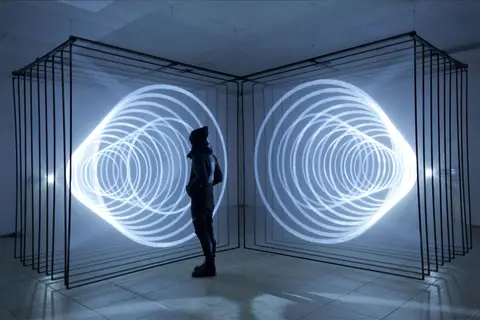
NONOTAK explain DAYDREAM V2 through layered mesh screens in their interview with Stereolux. Light passes through successive surfaces and repeats an image, giving physical depth to two-dimensional projections. This version establishes a frontal viewing relationship; audiences can move across the front without blocking projectors positioned beyond the structure. For a comparable installation, how would the room preserve that projection path while giving visitors several useful positions from which to examine and compare the changing spaces?
Stereolux — NONOTAK interview ↗ · Reviewed 2026-10-10
For your project briefHow would the room preserve the projection path and provide several useful viewing positions?
Big Art Partners planning prompt Stereolux performance discussion
Live performance makes the artists part of the image
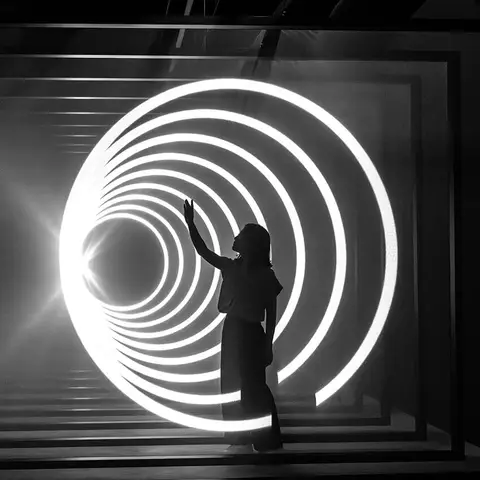
LATE SPECULATION incorporates the performers’ silhouettes into its images. At Stereolux, Noemi Schipfer and Takami Nakamoto explained that sound and visuals are triggered live, with projectors in front of and behind the structure creating shadows. Music preceded visuals, and a partly written sequence allowed variation. For a host, how would stage layout, rehearsal time and sightlines support these live choices while preserving the audience’s reading of the performers’ bodies inside the changing composition throughout the show?
Stereolux — NONOTAK interview ↗ · Reviewed 2026-10-10
For your project briefHow would layout, rehearsal and sightlines support live choices and visible silhouettes?
Big Art Partners planning prompt Aranya Art Center opening installation commissioned through OUTPUT
An LED floor responds to a cylindrical room
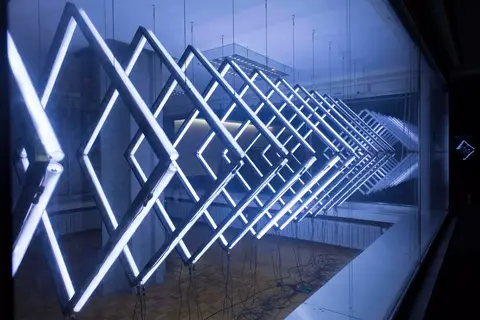
In their first-person interview with Derivative, NONOTAK describe MOON V.1 as a site-specific installation for the opening of Aranya Art Center, commissioned through OUTPUT. A circular LED floor answered the building’s cylindrical volume and its opening to the sky. Visitors could observe from surrounding steps or move onto the work, experiencing different relationships to the shifting light. This offers a useful precedent for designing around architecture. Which positions should support quiet observation, and which should invite the audience into direct contact with the changing image?
Derivative — first-person NONOTAK interview ↗ · Reviewed 2026-10-10
For your project briefWhich positions should support observation, and which should invite direct contact with the image?
Big Art Partners planning prompt