Research notes for project planning
What the project record tells us
Immersive inflatable exhibition
Bau(ncy) Haus: an inflatable route through changing light
Balloon Museum documents Bau(ncy) Haus as a 2018 freestanding inflatable labyrinth built from tubes of varying sizes. Programmed LEDs animate the structure, including sequences that switch the lights off before restoring them. The visitor's position changes how the patterns are perceived. This is useful evidence of an installation conceived around circulation and audience experience, rather than a sculpture viewed only from outside. The source does not supply an operating manual or a current touring schedule.
Balloon Museum — Bau(ncy) Haus ↗ · Reviewed 2026-10-10
For your project briefHow would the proposed layout handle visitor circulation, dark intervals, accessible routes and the installation's inflation equipment?
Big Art Partners planning prompt Hudson River Museum, Yonkers; June–September 2016
Tongue in Cheek: working with a museum's architecture
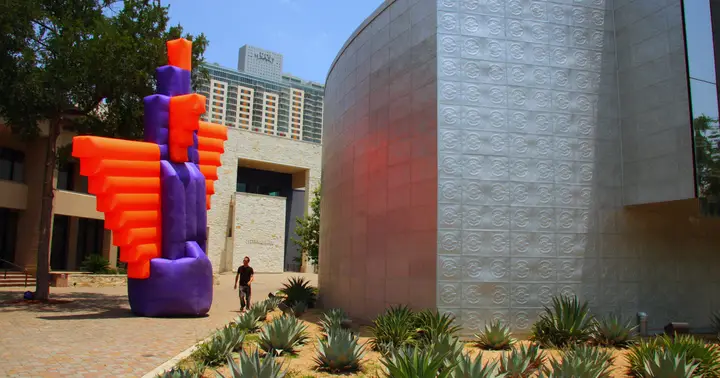
Hudson River Museum's 2016 exhibition placed Kuehnle's inflatables in both its historic Glenview house and its modern wing. Super Punch Bubbles occupied tower windows and used light to mark the hours; You Lick Me, I Lick You draped the entrance arch. The museum describes vinyl-coated polyester, electronics and installation work involving winches, pulleys and rigging. These are specific precedents for adapting inflatable sculpture to architectural openings and existing rooms, not evidence that the same assemblies fit another building.
Hudson River Museum — Tongue in Cheek ↗ · Reviewed 2026-10-10
For your project briefWhich attachment points, building protections and installation access would a venue approve before an architectural inflatable is designed?
Big Art Partners planning prompt Nagoya public performance, 2008
Big Red: sculpture as a mobile performance
Kuehnle's account of Big Red identifies a handmade inflatable suit presented in Nagoya in 2008. A 12-volt blower allowed the performer to move without a mains-power tether. The artist gives approximate dimensions of 16 feet tall, 24 feet wide and 15 feet long, using about 160 yards of fabric. The work is a precedent for sculpture that moves with a performer through public space. Those historical dimensions do not establish transport dimensions or operating clearances for a future event.
Jimmy Kuehnle — Big Red ↗ · Reviewed 2026-10-10
For your project briefWould the program call for a supervised performance route, a stationary presentation or a newly designed work, and who would establish weather and crowd limits?
Big Art Partners planning prompt